
May 21, 2026comparison · ikea-pax · custom-closet
Custom Closets vs IKEA PAX — An Honest Comparison
By David Carn, Owner, Cutting Edge Closets
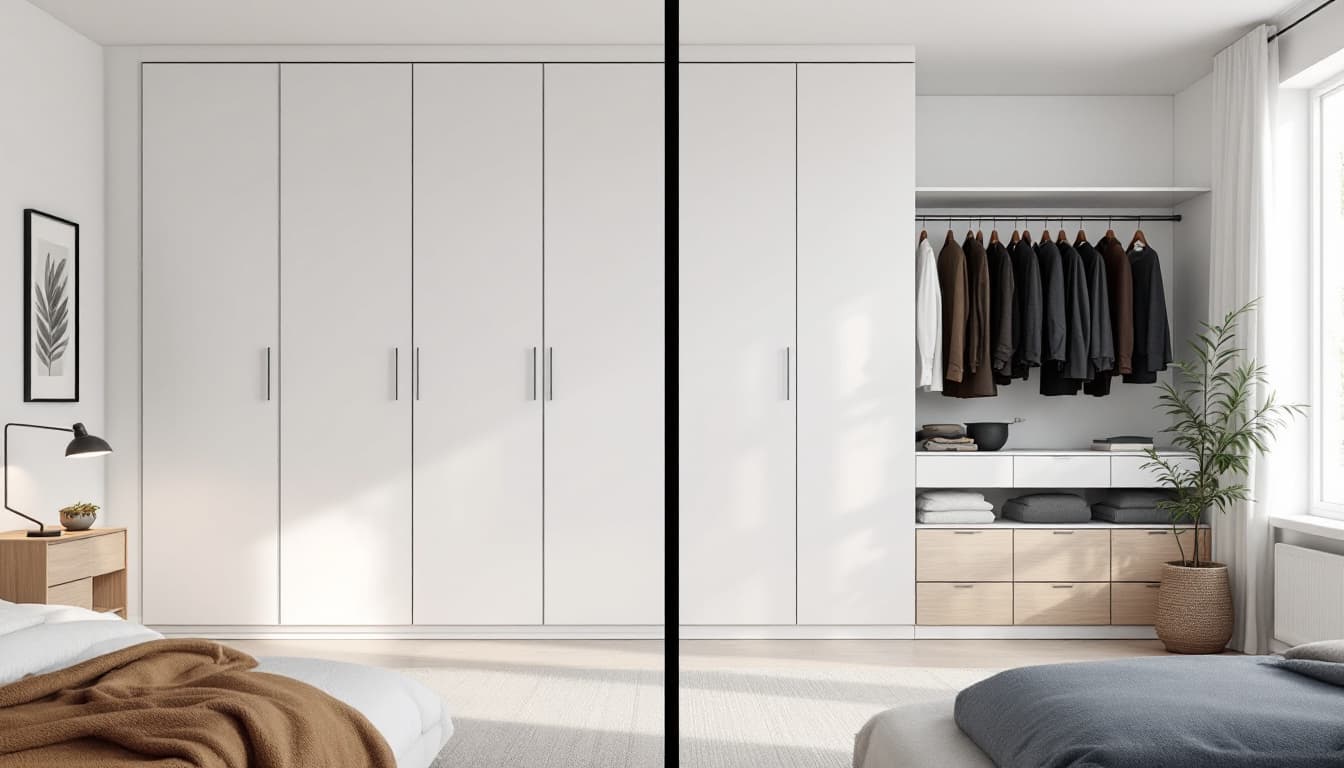
What does IKEA PAX do well?
PAX is the best-in-class flat-pack modular wardrobe system, and it does several things genuinely well: it's available immediately at known prices, the basic line is competent and durable, and the configurator is easy to use. For a square room with standard ceilings and a flexible plan, it can land you a perfectly usable closet for a fraction of the cost of custom. Specifically:
- You can buy it today. Drive to IKEA, fit the boxes in a van (barely), and start building tonight. No measuring service, no design phase, no scheduling.
- The price is fully transparent. What the configurator shows on ikea.com is what you pay. You can shop the entire range yourself before talking to anyone.
- The basic build is competent. Frames are solid, panels are well-finished, the system holds up to normal use as long as it's anchored properly to the wall.
- It's modular. If you move, it comes with you. If your needs change, you can rearrange interior fittings without scrapping the whole system.
For a renter, a starter home owner, a guest room, a kid's room, or any space you're planning to redo in a few years anyway — PAX is the rational choice. We mean that.
Where does IKEA PAX fall short?
PAX is built around standard sizes — typically 19⅝", 29½", 39¼", and 39⅜" wide frames at fixed heights. Real rooms are not built around standard sizes. The gaps between what PAX offers and what your room actually measures are where PAX falls short:
- Sizes don't fit non-standard rooms. A room with 9-foot ceilings leaves a 2-foot dead zone above PAX (the system tops out at 93¾"). A wall that measures 7'4" wide can fit two 39¼" frames with 5" of dead space — or one 39¼" + one 29½" with 13" of dead space. Custom uses every inch.
- Angled walls, sloped ceilings, and bump-outs are not accommodated. PAX is rectangles. Custom is whatever shape your room is.
- Installation is on you. PAX is heavy, awkward to handle, and the instructions take time. If you're paying someone to install it, factor that into the cost comparison.
- Lighting is an afterthought. PAX does have an LED accessory line (STRIBERG, etc.) but it's strip lighting added on top of the system, not integrated into the cabinetry. Custom can be lit from the start.
- Accessory range is limited. PAX has pant hangers, valet rods, dividers, jewelry trays — a decent baseline. Custom has those plus tie/belt drawers, lined jewelry inserts, watch cases, integrated mirrors, soft-close drawer organizers, hidden safes, pull-out hampers in any dimension, etc. If you have specific needs, custom matches them; PAX gives you what's in the catalog.
- The lifespan of the cheaper internal hardware is shorter. PAX frames are durable. The lower-tier drawer slides and hinges are not in the same class as the hardware on a quality custom build.
- No real resale benefit. Buyers treat PAX as furniture (it is). A built-in custom closet shows up in listings and appraisals as part of the home.
How does the comparison actually break down?
Here is the side-by-side. We're trying to be honest — including in places where PAX wins.
| Factor | IKEA PAX | Custom (Cutting Edge) | |---|---|---| | Up-front cost | Lower — published prices on ikea.com | Higher — every project quoted to the specific room | | Speed | Same day available; install in a weekend | Consultation → quote → fabrication → install, typically 4–8 weeks | | Fit to the room | Standard widths/heights; dead space common | Built to the exact dimensions; no dead space | | Material grade | Foil-laminated particleboard | Melamine, wood veneer, or solid wood | | Hardware (default) | Mixed; soft-close costs extra | Soft-close standard on most builds | | Lighting | Add-on strip lighting (STRIBERG) | Integrated, optional motion sensors, dimmer-ready | | Accessories | Catalog selection — solid baseline | Custom selection — match how you actually use the space | | Angled walls / sloped ceilings | Not accommodated | Built to the geometry | | Lifespan (with normal use) | Frame ~15 years; cheaper internals 5–10 | Frame 25+ years; quality hardware decades | | Installation | DIY or hire it out separately | Included in the quote | | Warranty | IKEA standard warranty (varies by component) | Lifetime warranty on installation | | Resale value | None — PAX goes with you | Adds value as a built-in fixture | | Best fit | Rentals, starter homes, kids' rooms, guest rooms | Primary closets, forever homes, non-standard rooms |
When does custom make sense over PAX?
Five situations where custom is the clearly better answer, and one where PAX is. We're not trying to talk you into one or the other — we'd rather you make the right call for your specific room.
Custom is the better call when:
- The room isn't a standard rectangle. Angled walls, sloped ceilings under stairs, bump-outs around plumbing, dormer windows. PAX can't fit these; custom is built for them.
- You want full ceiling height. PAX tops out at 93¾". If your ceilings are 9 feet (108") or 10 feet (120") and you want storage all the way up, custom is the only option that doesn't leave dead space.
- You're in your forever home (or close to it). Lifespan and lifetime warranty matter when you'll use the closet for decades, not years.
- You want it to add resale value. Built-in custom shows up in listings; PAX doesn't.
- You have specific accessory needs. Jewelry inserts, watch cases, integrated mirrors, soft-close drawer organizers fitted to your exact items, in-cabinet lighting, hidden safes — custom can hit any of these; PAX gives you what's in the catalog.
PAX is the better call when:
The room is a standard rectangle with standard ceilings, you want the closet done this weekend, the budget is the deciding factor, and you don't plan to stay in this home long enough to need a 25-year frame. That's a real situation for a lot of households, and PAX serves it well. No shame in that answer.
If you're not sure which side of the line your room falls on, book a free in-home consultation. We'll come measure, look at your space, and tell you honestly which approach is the better fit — including telling you to go to IKEA if that's the right call. We're across the Wasatch Front including Salt Lake City, Park City, and Provo, and we've been building custom closets here since 2009. We also build garages, pantries, home offices, and mudrooms — same approach: measure the room, design to the room, install to last.
Frequently asked questions
Is custom worth it over IKEA PAX?
It depends on the room and how long you'll use it. PAX is the right answer when the room has standard dimensions, you want it done this weekend, and you're not planning to stay forever. Custom is the right answer when the room is non-standard (angled walls, sloped ceilings, awkward dimensions), you want it to last, you want it to add resale value, or the standard PAX sizes leave dead space.
Can you install IKEA PAX for me?
We don't install PAX. There are local handypeople in Utah who do this — search 'IKEA furniture assembly' and you'll find them. If you're considering PAX vs. custom and want a side-by-side, we're happy to do a free in-home consultation; if PAX turns out to be the right call for your room, we'll tell you.
What about Container Store / Elfa systems?
Elfa sits between PAX and full custom. It's wire-and-melamine on a track system, modular like PAX but with more sizing flexibility. It works well in spaces where you want easy reconfiguration later. The look is more utilitarian than custom; the durability is good. Same shopping advice applies — get the in-home measurement, compare honestly.
Will PAX devalue my home?
Not really — but it doesn't add value the way built-in or custom does. PAX reads as furniture; appraisers and buyers treat it like furniture, which means it goes with you when you move (or gets disassembled). Built-in custom is part of the house and can show up as a positive note in listings, especially in primary closets.
How long does PAX last?
The frames last a long time if installed properly (anchored to studs, not just leaning against the wall). The interior fittings vary by line — the lower-cost drawer slides have a noticeably shorter lifespan than the soft-close ones. Custom hardware from a quality builder will outlast both.
I rent — should I do PAX or custom?
PAX, every time. Custom is built into the room; you can't take it with you. PAX comes apart and goes to the next place. The only exception: if you're renting from a family member long-term and they're willing to invest in the closet as a fixture, custom can still make sense.
Does PAX have a soft-close option?
Yes, on the upgraded drawer-slide line and on some hinges. You have to add them as separate line items — they don't come standard. With custom, soft-close is typically the default.
What does PAX cost to install?
PAX itself prices openly on IKEA.com; whatever the configurator says is what you pay. Installation is on you (or whoever you hire). Custom doesn't list prices because every project is different — we measure your specific space and quote it. The price gap between the two is real, but it shrinks once you add accessories, soft-close, lighting, and labor to a PAX build.
Ready for a real number on your closet?
Every closet is different. The most accurate way to know what yours will cost is a free in-home consultation — we measure, listen, and give you a real quote within a few days.
Get a free in-home consultationAbout the author
David Carn
Owner, Cutting Edge Closets
David Carn founded Cutting Edge Closets in 2009 and has built or overseen every custom closet, garage, pantry, mudroom, and storage room the company has installed across the Wasatch Front.